Project notes
When Symmetries Undermine Our Confidence in Generalization Bounds
A story of how rescaling symmetries in ReLU networks undermine PAC-Bayes generalization bounds, and our theoretical solution to restore meaningful guarantees.
Unpacking the Generalization Enigma
The remarkable success of deep neural networks (DNNs) presents a profound paradox: these models are often heavily overparameterized, meaning they possess millions of weights yet perform flawlessly on unseen data. Classical learning theory, which suggests that high capacity should lead to severe overfitting (memorizing the training set and failing to generalize), struggles to explain this phenomenon.
To build reliable AI, we need theoretical tools that can rigorously quantify the difference between a model’s performance on the training data (\(\hat{L}_{\mathcal{S}}\), the empirical risk) and its true performance on the entire unknown data distribution (\(L\), the expected risk).
Traditional bounds, derived from concepts like VC-Dimension and Rademacher Complexity, aim to provide a uniform guarantee for an entire class of functions (ie. all the possible functions output by our learning algorithm). However, because these bounds are worst-case and independent of the actual learning process, they are notoriously loose, often yielding vacuous results (e.g., “the error is less than 100%”).
This failure motivated the shift toward frameworks that incorporate the learning algorithm and the data, such as the PAC-Bayes theory.
The PAC-Bayes Framework: A Localized Measure of Complexity
The PAC-Bayes framework offers a more adaptive approach. Instead of analyzing a single deterministic model, it analyzes a distribution over models \(Q\) (the posterior), comparing it against a reference distribution \(P\) (the prior). This framework yields a bound that is data-dependent and often much tighter: \(\text{Expected Risk } (L) \leq \text{Empirical Risk } (\hat{L}_{\mathcal{S}}) + \text{Complexity Penalty}\)
The Complexity Penalty is where the problem lies. It is primarily driven by the Kullback-Leibler (KL) Divergence \(D_{KL}(Q\Vert P)\) between the learned posterior \(Q\) and the prior \(P\) in the high-dimensional weight space \(\mathcal{W}\).
\[\text{Complexity Penalty} \propto \sqrt{\frac{D_{KL}(Q\Vert P)}{|\mathcal{S}|}}\]The logic is sound: if the learned distribution \(Q\) is simple and close to a chosen prior \(P\) (low \(D_{KL}\)), the model hasn’t used much capacity and should generalize well. The problem is that the weight space is redundant.
The Redundancy Trap: Rescaling Invariances
Our work focuses on networks that use the Rectified Linear Unit (ReLU) activation function, \(x \mapsto \mathrm{max}(0, x)\). This function has the critical property of positive homogeneity: for any \(\lambda > 0,\; \mathrm{ReLU}(\lambda x) = \lambda \mathrm{ReLU}(x)\).
This property creates a redundancy known as rescaling invariance. For any hidden neuron in the network, we can construct an entire equivalence class of weight vectors \(\diamond^{\lambda}(w)\) that all realize the exact same function \(f_w\). This is achieved by:
- Multiplying the weights entering the neuron by \(\lambda\).
- Dividing the weights leaving the neuron by \(1 / \lambda\).
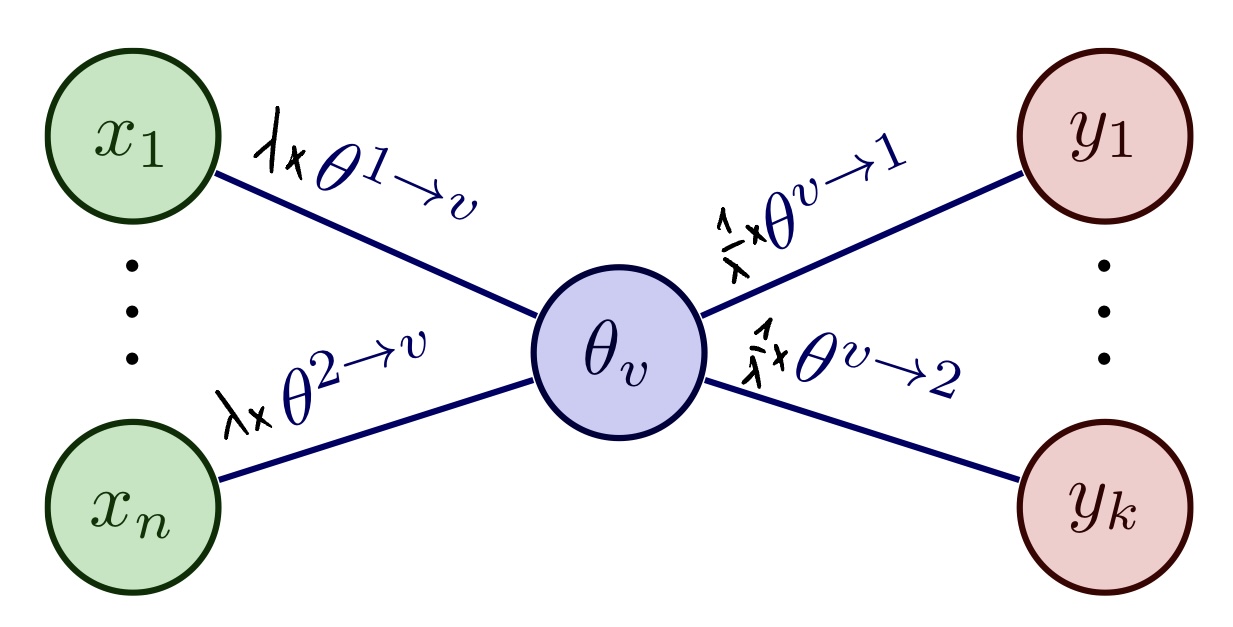
The devastating consequence for PAC-Bayes: Because the standard bound measures complexity in the raw weight space \(\mathcal{W}\), two weight distributions \(Q\) and \(P\) that are functionally identical (i.e., they define the same network function \(f\)) can be arbitrarily far apart in terms of \(D_{KL}(Q\Vert P)\) simply by choosing different internal scaling factors \(\lambda\).
This means the \(D_{KL}\) term—the supposed measure of functional complexity—can be artificially inflated by simple scaling, leading to generalization bounds that are vacuously large and theoretically useless, despite the function being simple and generalizing well in practice. The complexity measure is fundamentally misaligned with the functional equivalence of the models.
Our Theoretical Correction: Invariant Lifted Representations
To restore the validity of the PAC-Bayes framework, we must analyze complexity in a space that is invariant to these arbitrary scaling factors. We introduce the concept of an Invariant Lifted Representation \(\mathcal{Z}\).
The solution involves defining a map, or “lift” \(\psi: \mathcal{W} \rightarrow \mathcal{Z}\), which projects the high-dimensional, redundant weight space \(\mathcal{W}\) down into a lower-dimensional, symmetry-free space \(\mathcal{Z}\). Any two weight vectors belonging to the same functional equivalence class (i.e., related by a rescaling operation) will be mapped to the same point \(\psi(w) = \psi(\diamond^{\lambda}(w))\). A special candidate for this lift is called the path-lifting.
The Core Result: We formally prove that the PAC-Bayes bound holds when the complexity is measured using the lifted divergence \(D_{KL}(\psi_\sharp Q\Vert \psi_\sharp P)\) in this new space \(\mathcal{Z}\).
Furthermore, we use the Data Processing Inequality (DPI) from information theory to establish the superiority of this approach: applying any function (like our lift \(\psi\)) to two random variables (the weight distributions \(Q\) and \(P\)) can only reduce or preserve the information distance between them. This yields the crucial theoretical guarantee:
\[D_{KL}(\psi_\sharp Q\Vert \psi_\sharp P) \le D_{KL}(Q\Vert P)\]This guarantees that the invariant, lifted bound is always tighter than the original weight-space bound, formally demonstrating that correcting for symmetries leads to better theoretical guarantees.
Practical Implementation and Impact
While calculating the exact optimal lifted KL is challenging, the DPI provides a computable upper bound that is guaranteed to be tighter than the original: the Deterministic Rescaling Infimum. This term involves minimizing the KL divergence across all possible scaling factors \(\lambda\).
\[D_{KL}(\psi_\sharp Q\Vert \psi_\sharp P)\le \inf_{\lambda,\lambda^{\prime}}D_{KL}(\diamond_\sharp^{\lambda}Q\Vert \diamond_\sharp^{\lambda^{\prime}}P) \leq D_{KL}(Q\Vert P)\]We developed an efficient and provably convergent Block Coordinate Descent (BCD) algorithm to find the optimal scaling vector \(\lambda^*\) that minimizes this proxy bound.
Our experiments confirmed the practical impact:
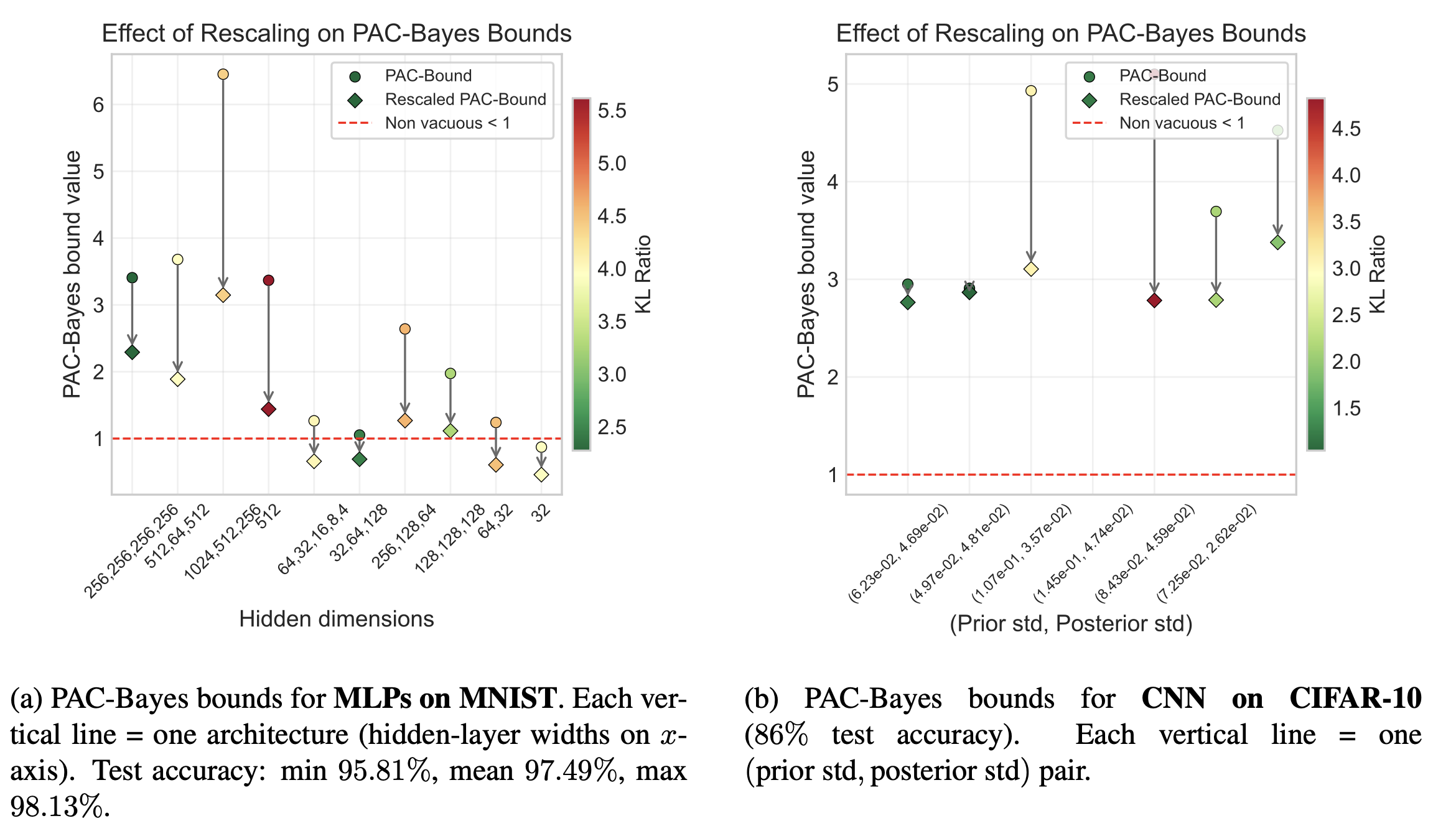
- Divergence Reduction: The optimal rescaling procedure consistently reduced the measured KL complexity term by factors of up to five.
- Bound Tightening: This reduction directly translated into significantly tighter PAC-Bayes generalization bounds, often reducing them by half.
- Validity Restoration: Critically, in many real-world scenarios, this correction transformed bounds that were vacuous (offering no useful information) into informative, non-vacuous guarantees.
This research provides a necessary theoretical improvement to the PAC-Bayes framework, ensuring that our complexity measures are robust against the architectural symmetries inherent in ReLU networks, thereby bridging the gap between deep learning practice and generalization theory.